GPT-5 Pro at $200 a month: what the pricing tier signals to enterprise IT
OpenAI's GPT-5 Pro tier launched in August 2025 with no benchmarks and a $200/month subscription. The pricing decision is more interpretable than the capability claim. What the tier signals for enterprise procurement and how the McKinsey 17% EBIT-attribution figure cited around the launch should actually be read.
Partial·reviewed28 May 2026·next-96d
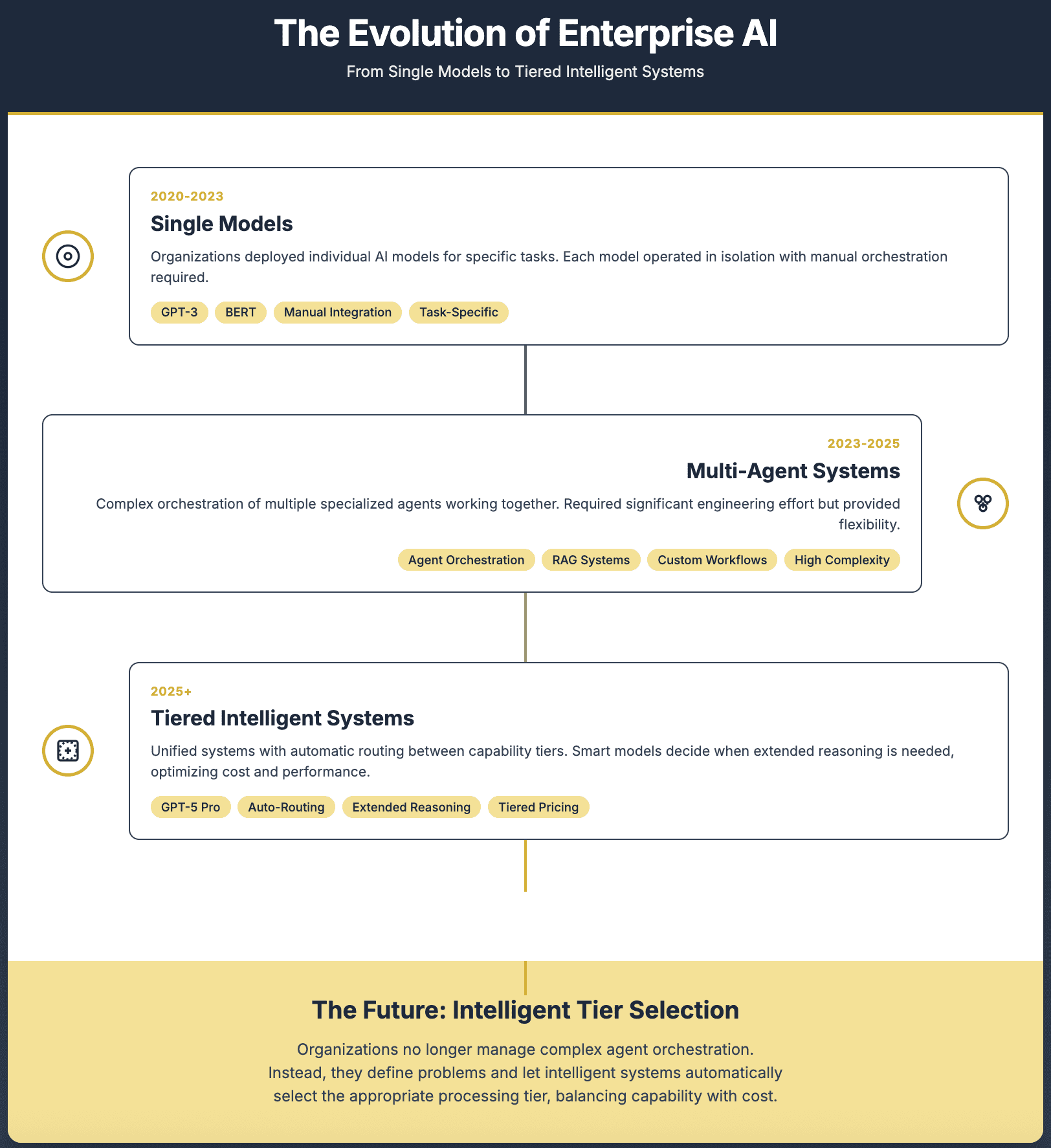
Greg Brockman, co-founder of OpenAI, tweeted about “GPT-5 Pro for very hard problems” on 14 Aug 2025, marking a strategic shift in how enterprise AI is packaged and priced. No detailed specifications. No benchmark comparisons. Just a signal that computational power now comes in clearly defined tiers.
The immediate implication for IT is economic, not technical. GPT-5 Pro is currently available only through ChatGPT’s $200/month Pro tier, with the system “knowing when to respond quickly and when to think longer to provide expert-level responses.” That capability sits in a subscription product, not an API call — which means carefully-orchestrated multi-agent systems now compete directly with per-seat tooling on the same desks.
McKinsey’s State of AI 2025 reports that 17% of respondents say 5% or more of their organization’s EBIT in the past 12 months is attributable to gen AI. The figure is a self-reported attribution from approximately 1,491 senior leadership respondents — not an audited measurement. The way the figure is typically deployed in CIO decks materially overstates what the survey supports; the longer treatment of the citation chain on this specific number is at AM-033. GPT-5 Pro adds a second layer to that problem: premium processing that may or may not repay its cost, depending on what problems the organisation actually hands it.
The relevant enterprise question is not whether GPT-5 Pro is capable. It is. The question is whether the top-decile of queries an organisation runs actually need it, and whether pairing premium processing with existing multi-agent infrastructure produces compounding value or parallel cost. Enterprises without a formal AI strategy report 37% success in AI adoption compared with 80% for those with a strategy; a premium subscription tier does nothing to close that gap.
Companion: 2-minute Spotify episode on this piece
Strategic Content
Market Context & Trends
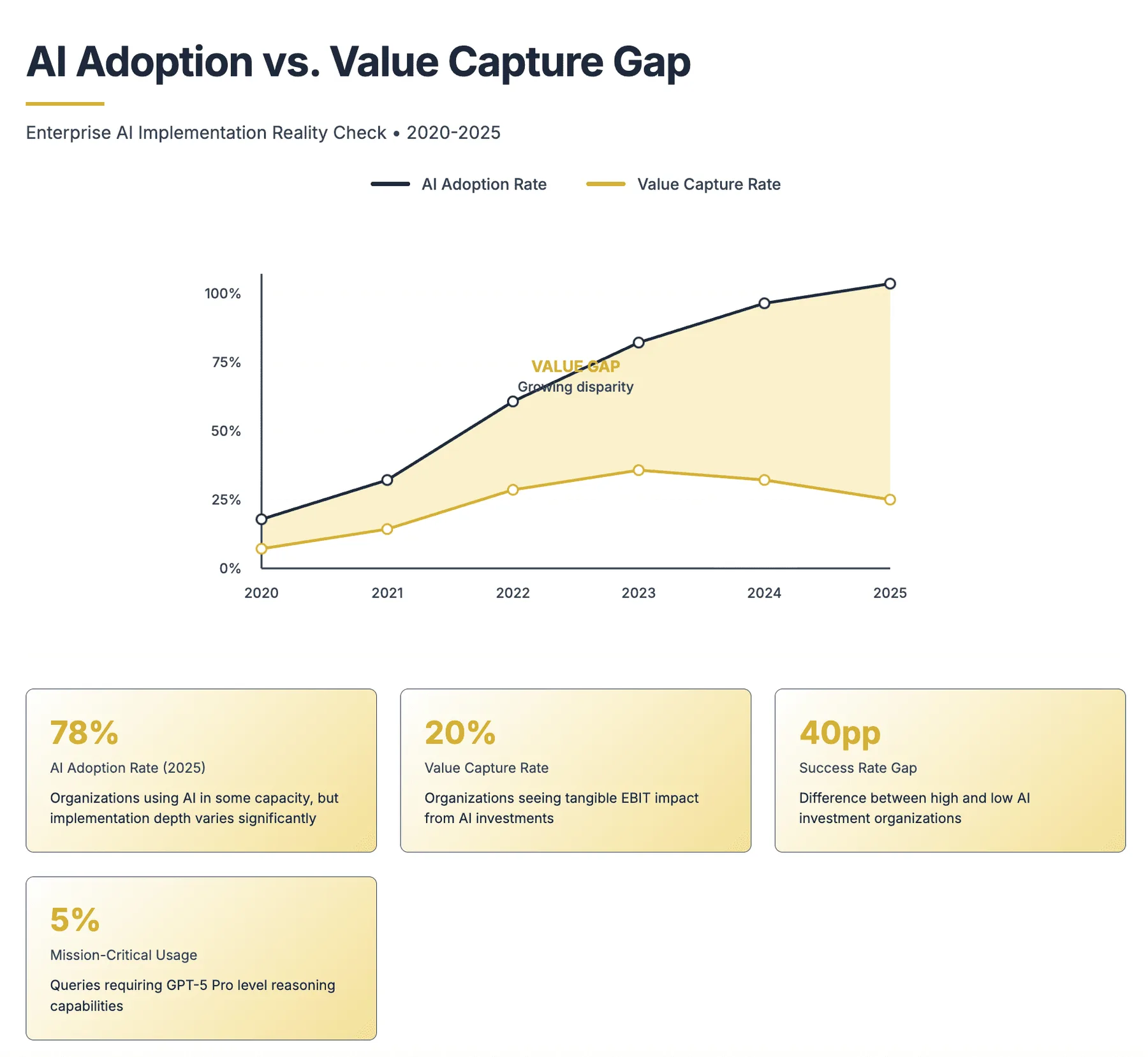
The enterprise AI landscape reveals a sobering reality gap. While Stanford’s 2025 AI Index reports that 78% of organizations will use AI in 2024, the value capture remains elusive for most. GPT-5 official launch on 7 Aug 2025 introduced a tiered approach that fundamentally changes the economics of AI deployment.
Current Market Dynamics
Adoption Without Impact
- More than 80 percent of respondents say their organizations aren’t seeing a tangible impact on enterprise-level EBIT from their use of gen AI
- This suggests that raw capability alone, even at GPT-5 Pro levels, won’t guarantee ROI
Investment Concentration
- There’s a 40 percentage-point gap in success rates between companies that invest the most in AI and those that invest the least
- Premium tiers like GPT-5 Pro may widen this gap further
Geographic Disparities
- Organizations in India (59%), the UAE (58%), Singapore (53%), and China (50%) are leading the way in active use of AI
- Lagging markets include Spain (28%), Australia (29%), and France (26%)
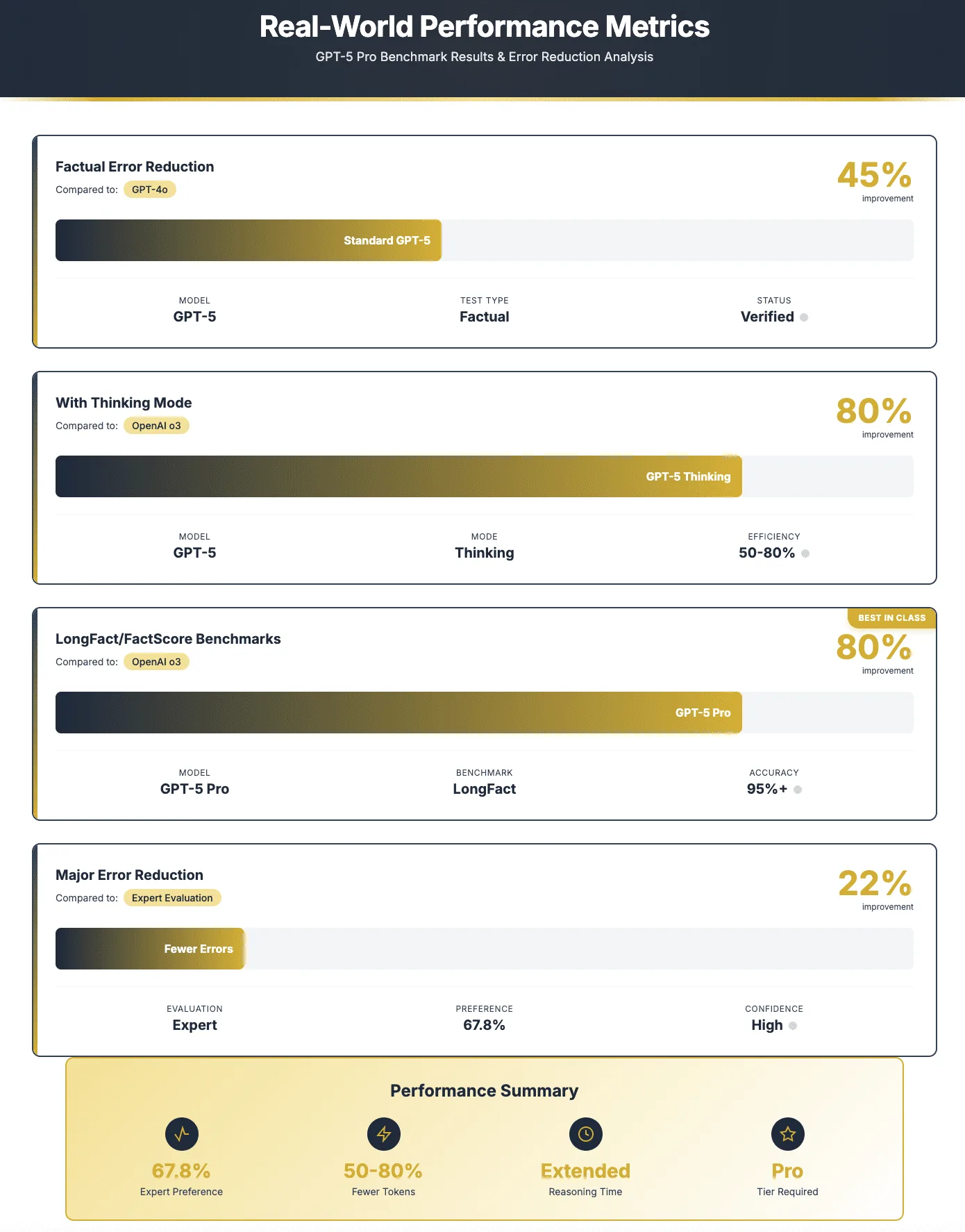
The data reveals something unexpected: GPT-5 gets more value out of less thinking time. In evaluations, GPT-5 (with thinking) performs better than OpenAI o3 with 50-80% less output tokens. This efficiency fundamentally alters the cost equation, though the $200/month Pro tier still requires careful justification.
Reality Check on Pricing
The pricing structure reveals the new economics (figures from OpenAI API pricing, Anthropic Claude API pricing, and OpenAI ChatGPT plans, retrieved 15 Aug 2025):
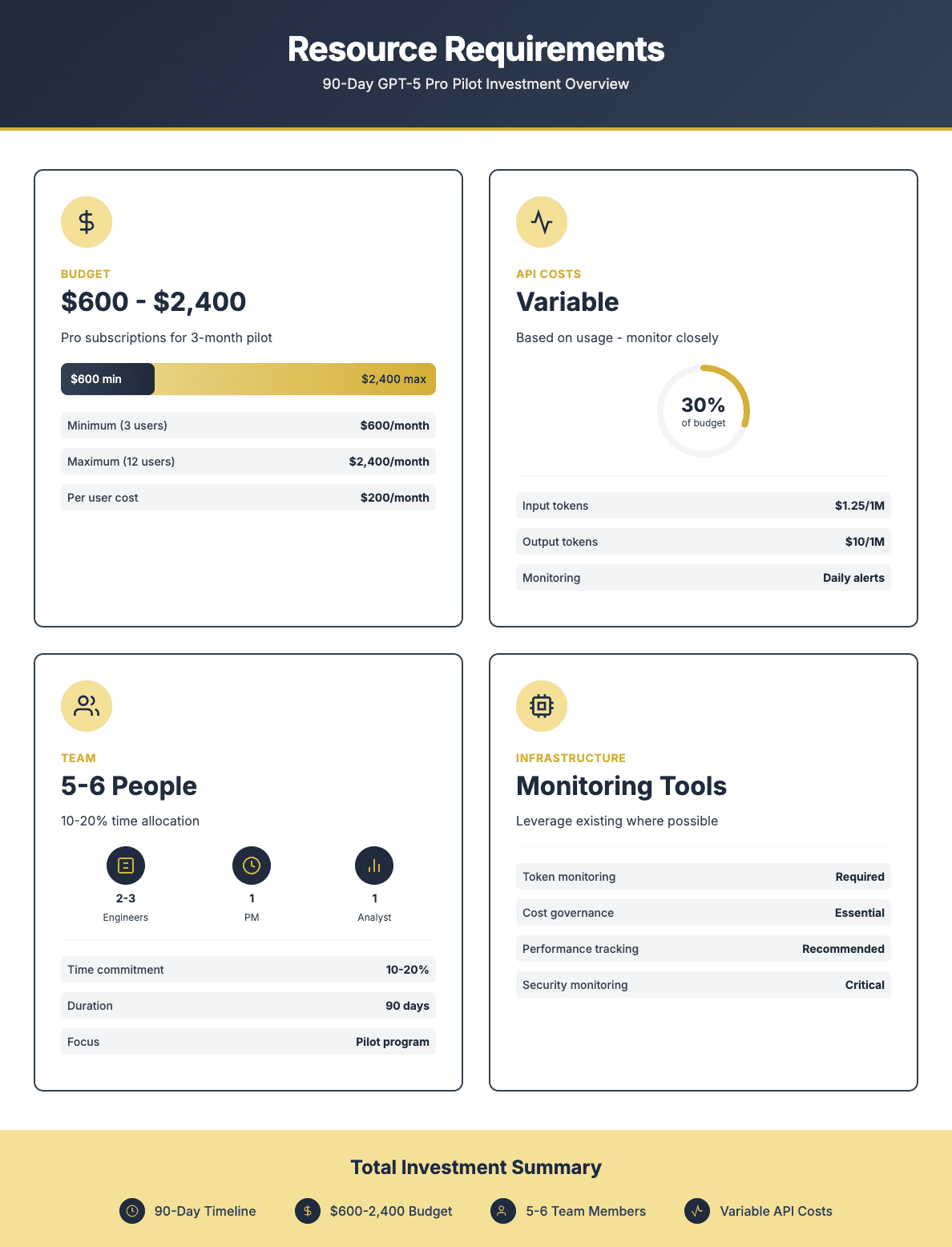
- GPT-5 API: $1.25 per 1 million tokens of input, $10 per 1 million tokens for output
- Claude Opus 4.1: Starts at $15 per 1 million input tokens and $75 per 1 million output tokens
- GPT-5 Pro subscription: $200/month for extended reasoning capabilities
While GPT-5’s pricing appears competitive, the Pro tier’s extended reasoning capabilities come at a significant premium through the subscription model.
Implementation Framework
Successfully deploying GPT-5 Pro requires strategic thinking about problem classification. Based on patterns from early adopters, here’s a practical framework:
Step 1: Problem Classification Matrix
Organizations seeing success with tiered AI follow this distribution:
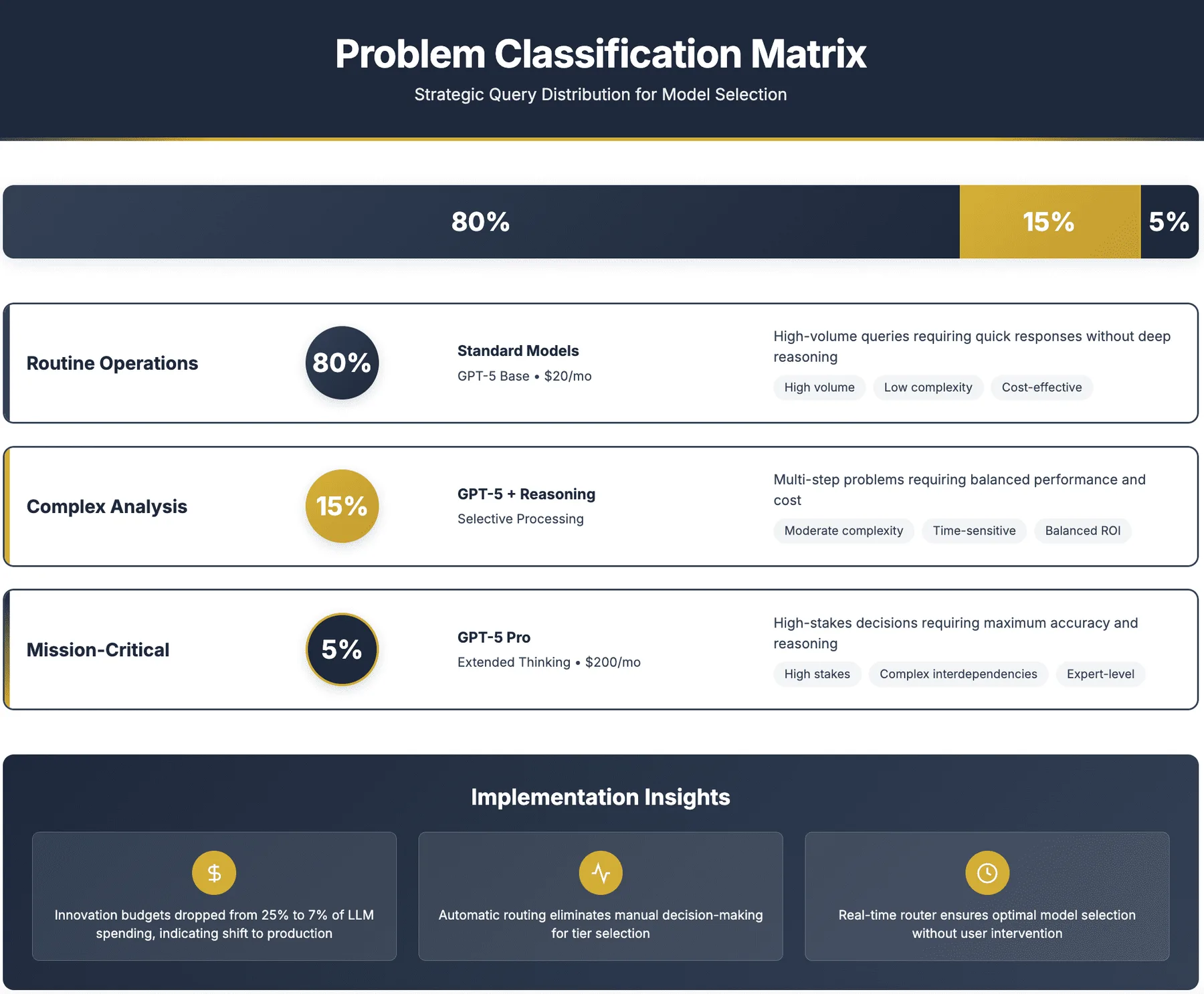
This aligns with findings that innovation budgets still made up a quarter of LLM spending last year; this has now dropped to just 7%, indicating a shift toward production use cases.
Step 2: Hybrid Architecture Design
GPT-5 is a unified system with a smart, efficient model that answers most questions, a deeper reasoning model for harder problems. Your architecture should mirror this approach:
-
Intelligent Routing
- Implement query classification based on complexity indicators
- Use confidence thresholds to trigger premium processing
-
Token Budget Management
- Monitor actual consumption against business value
- Set alerts for unusual usage patterns
-
Fallback Chains
- Design graceful degradation when hitting usage limits
- Maintain service continuity with model switching
-
Performance Monitoring
- Track reasoning requirements vs. outcomes
- Measure accuracy improvements per tier
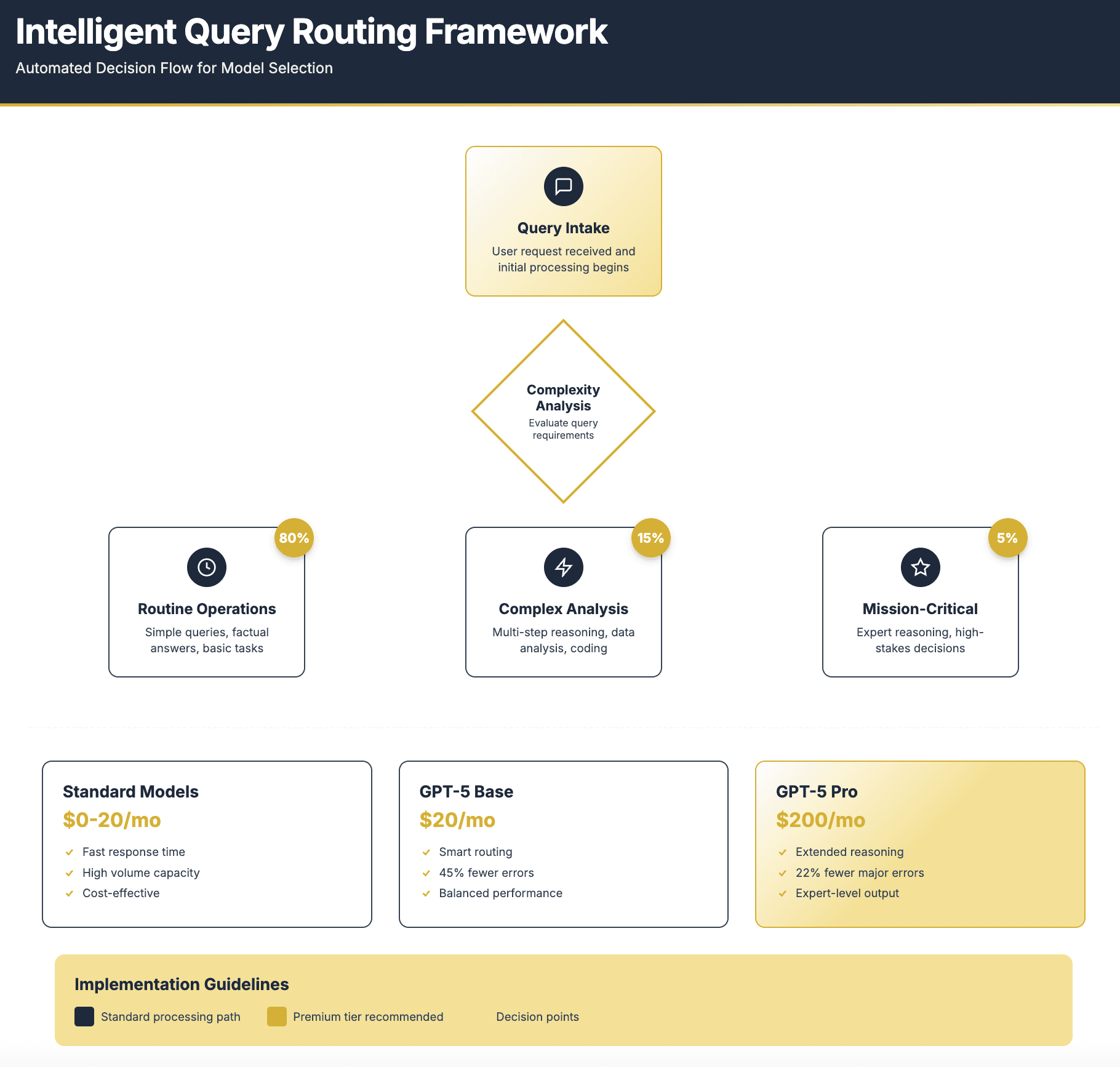
Microsoft’s implementation provides a template: “Through Microsoft 365 Copilot and Microsoft Copilot, enterprise and consumer users can automatically get the benefit of powerful new AI reasoning capabilities without having to think about which model is best for the job, thanks to a real-time router.”
Step 3: Early Enterprise Patterns
Real organizations are seeing results:
- Amgen: “Increased accuracy and reliability, higher quality outputs and faster speeds compared to prior models” after deploying GPT-5 across workflows
- SAP: “Excited to be among the first to leverage the power of GPT-5 in Azure AI Foundry”
- Microsoft: Comprehensive integration across GitHub Copilot, Visual Studio Code, and Azure AI Foundry
These gains require careful orchestration and clear use case definition.
ROI Methodology
The economics of GPT-5 Pro require sophisticated analysis beyond subscription costs. While external experts preferred GPT-5 pro over “GPT-5 thinking” 67.8% of the time, preference doesn’t automatically translate to ROI.
Real-World Performance Metrics
Based on OpenAI’s data and early enterprise feedback:
Cost Analysis Framework
The actual cost structure breaks down as follows (all figures from OpenAI’s pricing page and ChatGPT subscription page, retrieved 15 Aug 2025):
Subscription Tiers
- Free Tier: Limited access (10 messages every 5 hours)
- Plus Plan: $20/month – Higher message limits
- Pro Plan: $200/month – Unlimited GPT-5 Pro access
- Team/Enterprise: Custom pricing with volume discounts
API Pricing (OpenAI API pricing, retrieved 15 Aug 2025)
- GPT-5: $1.25/1M input tokens, $10/1M output tokens
- GPT-5-mini: $0.25/1M input tokens, $2/1M output tokens
- GPT-5-nano: $0.05/1M input tokens, $0.40/1M output tokens
Hidden Costs
- Integration engineering time
- Training and change management
- Governance and compliance overhead
- Performance monitoring infrastructure
Execute the GPT-5 ROI calculator
Important Disclaimer: ROI varies significantly by organization and use case. Unlike fabricated “3.2x ROI” claims, real-world results depend on multiple factors including implementation quality, use case selection, and organizational readiness. PwC notes that “Making AI intrinsic to the organization is vital” for capturing value.
Risk Mitigation
The shift to GPT-5 Pro introduces new risk vectors that organizations must address:
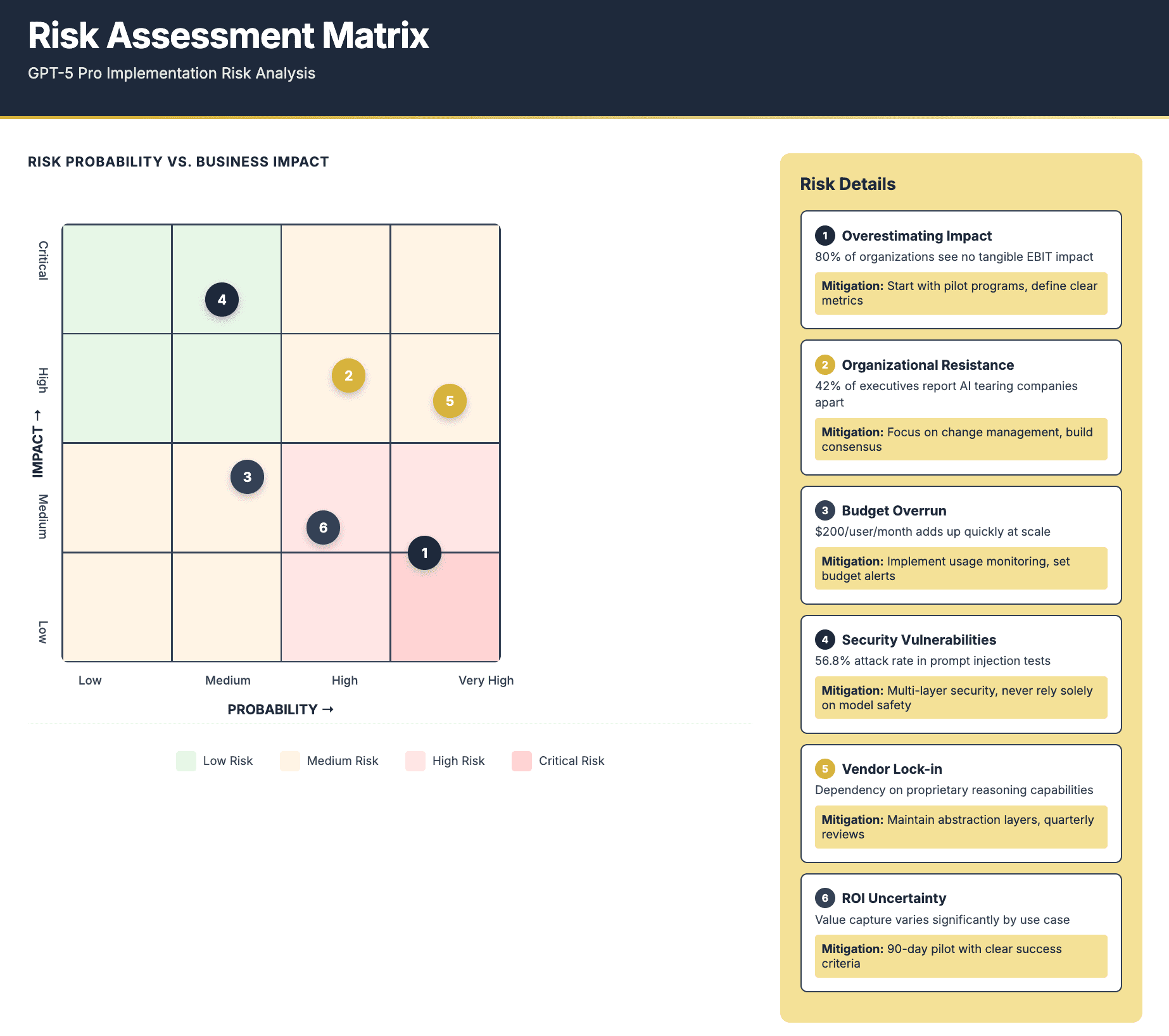
Common Pitfalls Based on Market Data
1. Overestimating Impact
- Risk: More than 80% of organizations aren’t seeing tangible EBIT impact from gen AI
- Mitigation: Start with pilot programs on specific, measurable use cases
- Success Metric: Define clear before/after metrics for each implementation
2. Security Vulnerabilities
- Risk: A 56.8% attack rate in prompt injection tests shows that more than half of k=10 attacks got through
- Mitigation: Implement multi-layer security beyond model capabilities
- Framework: Never rely solely on model safety features
3. Organizational Resistance
- Risk: 42% of C-suite executives report that AI adoption is tearing their company apart
- Mitigation: Focus on change management and clear communication
- Strategy: Build consensus before scaling deployment
4. Vendor Lock-in
- Risk: Architectural dependence on proprietary reasoning capabilities
- Mitigation: Maintain abstraction layers for model switching
- Review Cycle: Quarterly evaluation of competing models
Industry Applications
Different sectors are experiencing varied success with advanced AI capabilities:
Healthcare and Life Sciences
- Performance: GPT-5 sets a new state of the art in health (46.2% on HealthBench Hard)
- Enterprise Example: Amgen reports “promising early results from deploying GPT-5 across workflows including increased accuracy and reliability”
- Use Cases: Drug discovery, diagnostic support, clinical documentation
Financial Services
- Adoption Rate: About half of IT professionals in financial services report active AI deployment
- Applications: Risk modeling, fraud detection, regulatory compliance
- Challenges: Balancing innovation with regulatory requirements
Technology and Software Development
- Microsoft Integration: Comprehensive deployment across GitHub Copilot and Visual Studio Code
- Performance: GPT-5 scored 74.9% on SWE-bench Verified and 88% on Aider polyglot
- SAP Implementation: “Leverage the power of GPT-5 in Azure AI Foundry within our generative AI hub”
Action Plan
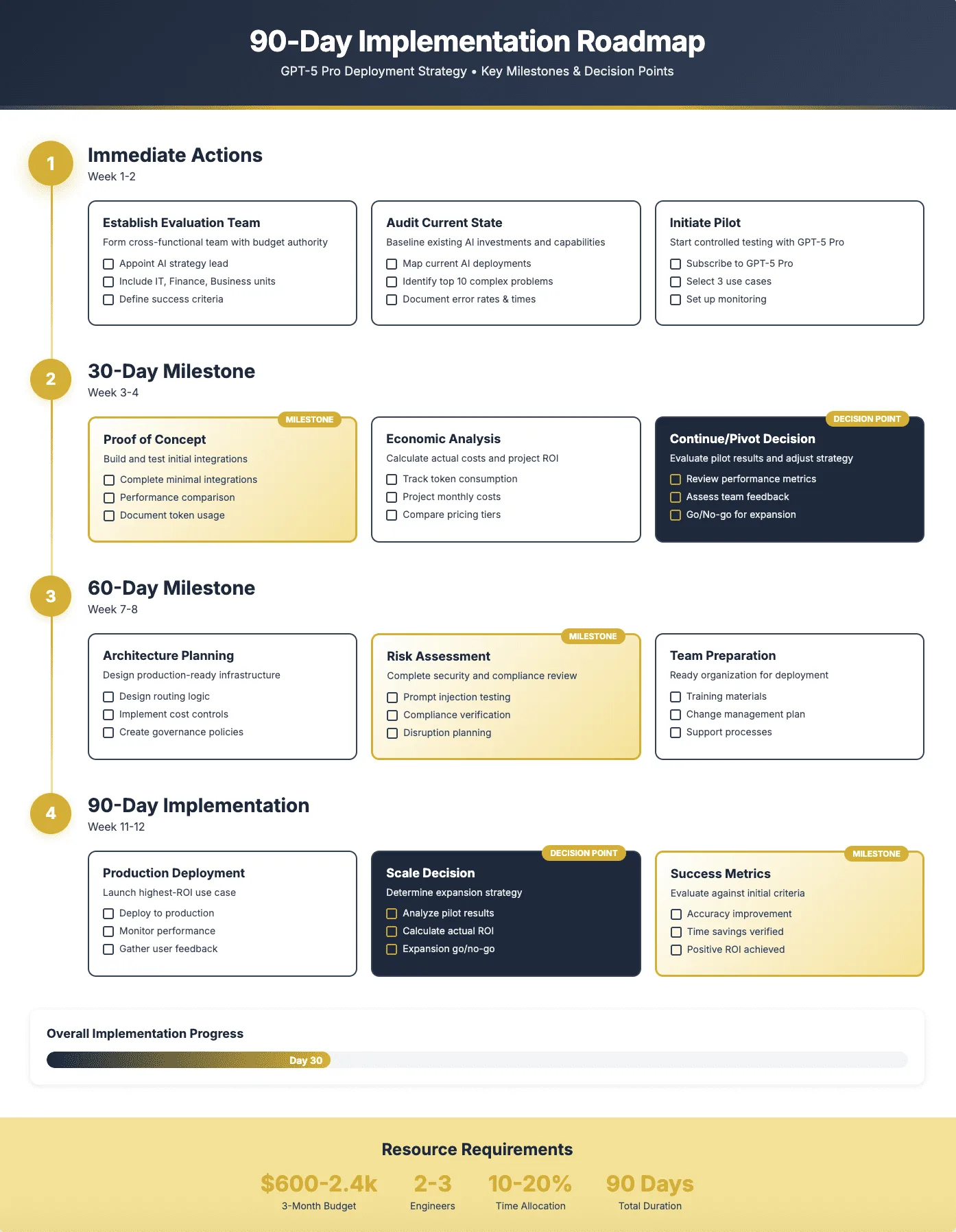
Based on analysis of successful enterprise deployments and market research, here’s your evidence-based 90-day roadmap:
Immediate Next Steps (Week 1-2)
-
Establish Evaluation Team
- Appoint AI strategy lead with budget authority
- Include IT, Finance, and business unit stakeholders
- Define success criteria based on the 80% success rate for companies with formal AI strategies
-
Audit Current State
- Map existing AI deployments and actual costs
- Identify top 10 problems requiring extended reasoning
- Baseline current error rates and processing times
-
Initiate Controlled Pilot
- Subscribe to GPT-5 Pro for limited testing
- Select 3 use cases with clear success metrics
- Document all costs and outcomes
30-Day Milestone
-
Proof of Concept Development
- Build minimal integrations for selected use cases
- Compare performance against existing solutions
- Calculate actual token consumption and costs
-
Economic Analysis
- Document real token usage patterns
- Project monthly costs at production scale
- Compare against the Plus ($20/month) and Pro ($200/month) subscription tiers
60-Day Milestone
-
Architecture Planning
- Design routing logic for tier selection
- Implement monitoring and cost controls
- Create governance policies
-
Risk Assessment
- Test for prompt injection vulnerabilities
- Assess compliance requirements
- Plan for service disruptions
90-Day Implementation
-
Production Deployment
- Launch highest-ROI use case
- Monitor performance metrics continuously
- Gather user feedback
-
Scale Decision
- Analyze pilot results against success criteria
- Calculate actual ROI (not projected)
- Make go/no-go decision on expansion
Resource Requirements
Success Metrics
- Measurable improvement in specific problem-solving accuracy
- Documented time savings on complex tasks
- Positive ROI within defined use cases
- No critical security incidents
- User satisfaction scores above baseline
Conclusion
The announcement of GPT-5 Pro for “very hard problems” represents a fundamental shift in how enterprise AI is packaged and priced. Greg Brockman’s cryptic tweet signals a new era where computational power comes in clearly defined tiers, each with distinct capabilities and costs.
The evidence suggests a nuanced reality. While GPT-5 Pro demonstrates superior performance with 22% fewer major errors and strong preference ratings from experts, the broader market data shows that most organizations struggle to capture tangible value from AI investments. Success with GPT-5 Pro won’t come from the technology alone but from strategic deployment on carefully selected problems.
Organizations that succeed will be those that:
- Develop clear frameworks for tier selection
- Implement robust governance and monitoring
- Maintain realistic expectations about ROI
- Focus on specific, measurable use cases
- Invest in change management alongside technology
The question isn’t whether GPT-5 Pro is powerful—it demonstrably is. The question is whether your organization’s “very hard problems” justify the premium investment and whether you have the organizational maturity to capture that value.
Take Action Now
Within 72 hours:
- Assemble your evaluation team
- Identify 3-5 specific problems that might justify GPT-5 Pro investment
- Run controlled pilots with clear success metrics
Most importantly: Be prepared to walk away if the ROI doesn’t materialize. For many organizations, it won’t.
The future of enterprise AI isn’t about having the most powerful models. It’s about knowing exactly when premium capabilities deliver real business value. That determination can only come from systematic evaluation, not vendor promises or market hype.
Important Note: All statistics and claims in this article are based on publicly available research and official statements. ROI and success rates vary significantly by organization. Conduct your own evaluation before making investment decisions.
Cite this article
Pick a citation format. Click to copy.
Correction log
- 28 May 2026Pricing/model drift: a $100/mo Pro tier now sits beside the $200 tier (added 9 Apr 2026) and the premium model is GPT-5.5 Pro. Core thesis holds; the single-$200-tier framing no longer matches. Re-verify current tiers at chatgpt.com/pricing.
Spotted an error? See corrections policy →
Reasoned disagreement is a first-class signal here. Every review cycle weighs documented dissent; material dissent becomes part of the article's change history. This is not a corrections form — use /corrections/ for factual errors.
Enterprise AI cost and ROI →
Verifying, tracking, and challenging the ROI claims vendors and analysts make about enterprise agentic AI. 30 other pieces in this pillar.